

2026 marks the 250th birthday of the United States of America. After a quarter of a millennium, America has achieved more than its founders could have ever conceived. With so much to celebrate, the USA’s financial evolution sometimes goes unappreciated.
It all began with fighting a war for independence and has resulted in the making of a major world superpower. Along with its commanding influence around the world, America has become the wealthiest country by many metrics.
Let’s take a moment to marvel at the historical growth of this economic giant.
GDP
Gross domestic product (GDP) represents the total value of all goods and services produced in a country during a specific time period. It can serve as an indicator of how efficiently the economy is running over time. By checking a country’s historical GDP you can gauge the rate at which it has grown. While GDP isn’t the only metric used to track the size of an economy, it is one of the most popular.
Below is a chart that shows America’s GDP growth since 1790 accounting for inflation (data sourced from measuringworth.com).
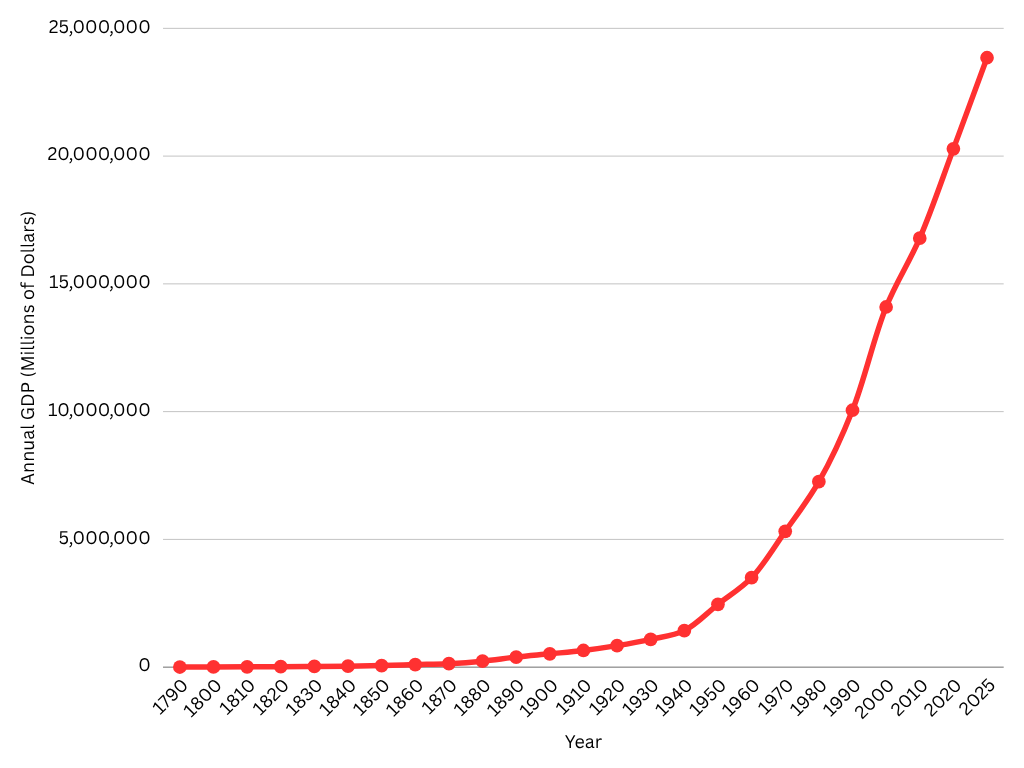
This graph shows explosive exponential growth from the time of America’s founding. Since 1790, the real GDP grew at an average rate of 3.68% annually. This may not sound like a lot, but with centuries of time for compounding growth to work its magic you get graphs like this.
The periods where growth was at its highest were The Gilded Age (1870-1900) and The Post-War Boom (1945-1970). These time periods usually yielded about 4%+ annual GDP growth caused by large increases in supply and demand, among other historical factors.
GDP per Capita
GDP is a great statistic to check on the growth of a country as a whole, but what about its quality of life? GDP per capita measures the amount of GDP a country has for each person. Here is a graph of America’s GDP per capita since 1790 accounting for inflation (data sourced from measuringworth.com).
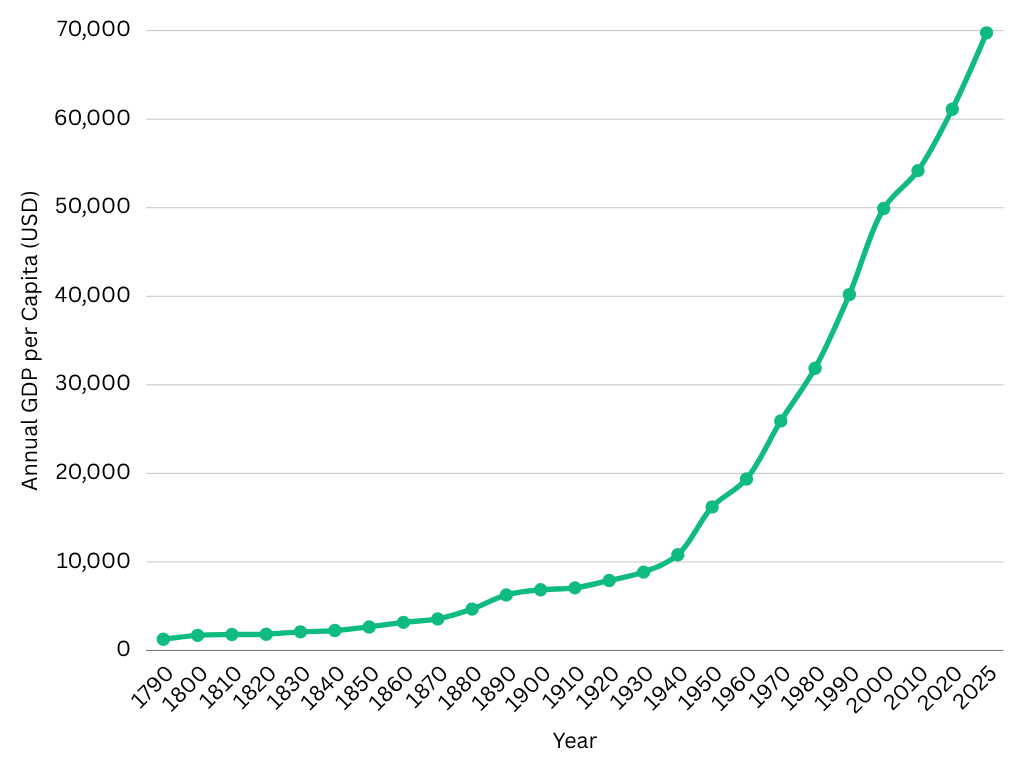
This graph demonstrates exponential growth in GDP per capita over the last couple of centuries. As expected, the GDP per capita grew less than real GDP during this period, compounding at a rate of 1.72%. This doesn’t seem like major growth, but with over 200 years to compound it works wonders.
Miraculously, the GDP per capita is demonstrating exponential growth while the American population follows a logistic curve. In simple terms, this means that population growth is slowing while GDP per capita continues to climb. It’s hard to comprehend just how impressive this is. America’s economic output continues to outpace population growth, defying the law of diminishing returns.
The Stock Market
In the last 250 years, investors who backed American industry received massive payouts. From its beginning in 1790, every dollar invested into the US stock market would be worth around 2.5 million dollars today, factoring in inflation (this estimate is calculated using data from Jeremy Siegel’s book, Stocks for the Long Run).
The S&P 500 is an index that tracks the largest 500 companies in the USA. It was created in 1957, and since then has averaged a 10.5% annualized return. This rate of growth is incredible when looked at as a way to take advantage of compound interest. If you want to learn more about how indexes can generate large returns over long periods of time, check out my post: Index Funds vs. Individual Stocks.
While the stock market has shown unbelievable growth, it doesn’t represent the real US economy in its entirety. Many companies will earn profits overseas which increases the value. Also, the value of a stock can be artificially boosted with share buy-backs even if real economic growth is slow. However, this is not to say that the success of the stock market doesn’t signal financial health. Looking at the GDP charts above, it’s no coincidence that the stock market’s most explosive growth periods mirror America’s greatest economic expansions.
America’s Biggest Scares
Despite all of the growth, it’s no secret that there have been periods of economic downturn. Here are some of the biggest scares that Americans have had to face.
- The Great Depression (1929-1941)
One of the hardest times to live through for the average American, The Great Depression lasted from the initial stock market crash in 1929 all the way up until the beginning of WWII in 1941. With unemployment reaching all time highs, an only partial recovery, and a “recession within the depression”, this was no doubt a time of fear surrounding America’s future.
- The Great Recession (2008)
The Great Recession was the longest lasting recession since WWII, triggered by the collapse of a housing bubble. The financial crisis was caused by widespread issuing of risky mortgages. With unemployment rising, government bailouts, and the stock market losing over half its value, the 2008 financial crisis was a major set-back for economic growth in the US.
- COVID-19 Pandemic (2020)
After a national lock down, unemployment spiked to its highest rates since the great depression. Because of the government-mandated lockdowns, the supply and demand came to a rapid halt. The world speculated as to how long this would last while the economy was turned off.
What we can learn from these crises is that America is durable. It may have taken years to recover from these emergencies, but in each case the economy was able to bounce back. Knowing that the US has faced multiple economic catastrophes and still continues to grow today should be a huge confidence booster for investors and workers alike.
A Global Comparison
America’s economy has been unmatched on the global scale. Based on pure economic output and speed of growth, there is no rival. Currently, America has the largest GDP among all countries in the world while still being relatively young compared to many of its peers.
While the capitalist model that America used has its flaws, no system has a higher claim to economic efficiency than the one used by the U.S. over the last 250 years. Today, the United States of America ranks in the top ten countries in nominal GDP per capita and has shown the most consistent and explosive growth throughout its lifespan. That’s not to say there haven’t been ups and downs or that there aren’t ongoing problems. National debt and inflation are both threats to the American economy.
As we celebrate 250 years, it’s important to exercise gratitude and understanding of the world we were born into. If you enjoyed this post, consider subscribing to my blog for more economic content and personal finance tips.
Discover more from Early Dividend
Subscribe to get the latest posts sent to your email.
Timely post and great reminder of our economic prosperity. Nicely put!